Lent 2018 - Day 15
Another entry in the Lent diary from my friend who is fasting from food during this season:
Wednesday, February 28, 2018 Day 15 of Lent
Prayer and fasting are a bit of a struggle today. I’m not sure what it is. I am hungry and a bit fatigued. My focus is lacking. My back is bothering me. The issue with my back has been difficult, not only physically with the pain and how that limits what I can do, but emotionally it is hard because I get frustrated and wonder if and when it will end. I have great sympathy for folks who have had chronic pain for years. You cannot underestimate the toll that takes on your emotional self. Anyway, I have hunger pangs now and getting into prayer today was more difficult.
During my scripture reading, one of the assigned readings was from Mark 4 – the parable of the sower and seeds. The third soil was full of thorns. People hear the word, but “the cares of the world and the lure of wealth, and the desire for other things come in and choke the word, and it yields nothing.” Of course, we want our hearts to be the good soil, but the traps of this third soil got me today. How many of us can say we are not distracted by the cares of the world? You don’t have to idolize money to be pulled away by the lure of wealth. I mean, how much have I thought about personal finances, will I have enough for retirement or that sort of thing? I don’t have to chase the new cars and boats to struggle with the ‘desire for other things.’ What takes my attention? The results of this third soil and thorns are “it yields nothing.”
Fasting is challenging because as this one thing is stripped away from me, it’s like the whole house of cards comes tumbling down, and I realize how tied in to this world I am.
Lent 2018 - Day 14
One of my closest friends practices fasting better than anyone I've ever met. Nearly every year during Lent, he fasts from food for six days in a row, eats on the Sabbath, and begins again the following day. I recently asked him to write about this practice, but being more Scripturally and spiritually attuned than I am, he begged off. Still, feeling there was value in others being able to read about this practice and with the possibility that others might even try to fast for a day for the first time in their lives, I convinced him to do it anonymously on my blog. He's going to keep a sort of diary each day and I'm going to share it here. I hope you find my friend's journey exciting and convicting.
-Matthew
Tuesday, February 27, 2018 Day 14 of Lent
Sunday evening I felt pretty hungry. I write that because that was unusual for last week, but I was ready to move into my eating day yesterday. A couple of things are developing though, in regards to my eating. First off, my stomach has shrunk down a bit, so I feel full a lot quicker than I normally would. This creates a problem because I often feel like I really need to eat on the day I eat, but I am not really able to eat as much as I initially want. On top of all of that, I eat like I normally would. Richard Foster, in his book, “Celebration of Discipline” talks about extended fasting (in an excellent chapter, btw) and that when you come off an extended fast you should ease into it with fruits and things like this. This is not how I do it, and my stomach hates me today for it. It’s a strange experience, but waking up the morning after eating, I feel a bit more sluggish and I have a bad taste in my mouth. Tuesday ends up being a day of getting back into balance. A final note on eating: I notice that our diet contains a lot of sodium. In our household, we aren’t even eating a ton of processed foods, really. But there is salt and sodium in everything, and I taste it more and more the longer the fast goes on.
My prayer life has gone well this year. There have only been a couple of times that I am not praying the four offices (morning, noon, evening, bedtime) each day. One of the things I find with my fasting is that I am much more consistent with prayer. It becomes a normal part of my routine. And I never know what is going to grab me from my prayer books. I think one of the things I want to focus on this week is the personal and relational aspect of prayer with God. By that I mean, I am experiencing much better focus, and I am challenged and convicted. I am aware of my dependence upon God, and I also feel grateful during different times. There is something about going without a main part of your life that brings into focus those things you take for granted and yet that are so important. These are all good and important things in the fast, but I think I need to either take note or pray more intentionally about experiencing the presence of God and the love of the Holy Spirit.
I’ll close with a reading from the Divine Hours that I read last night. It is a Celtic prayer:
The will of God be done by us;
The law of God be kept by us;
Our evil will controlled by us;
Our sharp tongue checked by us;
Speedy repentance made by us;
Temptation sternly shunned by us;
Blessed death welcomed by us;
Angel’s music heard by us;
God’s highest praises sung by us.
Lent 2018 - Day 10
One of my closest friends practices fasting better than anyone I've ever met. Nearly every year during Lent, he fasts from food for six days in a row, eats on the Sabbath, and begins again the following day. I recently asked him to write about this practice, but being more Scripturally and spiritually attuned than I am, he begged off. Still, feeling there was value in others being able to read about this practice and with the possibility that others might even try to fast for a day for the first time in their lives, I convinced him to do it anonymously on my blog. He's going to keep a sort of diary each day and I'm going to share it here. I hope you find my friend's journey exciting and convicting.
-Matthew
Friday, February 23, 2018 Day 10 of Lent
I’m at a point in the fast where my body really has adjusted to not eating. I am entering into what will be the best part of the fast physically. I’m not sure how long it will last. I do have periods of hunger. I had some yesterday, but they pass with time. I do have periods of being fatigued, but they are not so bad, and overall my energy level seems about the same as when I am not fasting. This will all change in time, however. I will become more fatigued, go to bed earlier, and I will become colder and always need a sweatshirt on. But for now, things are going well.
Spiritually, I feel like I am getting cleansed with a scrub brush. Most prayer times I have the last two days have involved me realizing some aspect of my life or my heart that is in disrepair. For example, this morning, as I began the daily prayer office, the opening verse was 1 John 1:8-9, “If we say that we have no sin, we deceive ourselves, and the truth is not in us; but if we confess our sins, God is faithful and just to forgive us our sins, and to cleanse us from all unrighteousness.” I was then lost in thought for a few minutes as I realized some of my sin. I am too quick to talk and a poor listener at times. I may be quick with an opinion, but it may not be thought out. Do I really listen to others? Especially those with whom I disagree? Why am I defensive? I get distracted so easily sometimes. Am I really focused on living for God like I need to be? Do other people experience me as exuding the grace of God? Shouldn’t they? What would that look like, and why am I not there?
I don’t know, it was a bunch of stuff that ran through my head. In the beginning of that service, not too long after that verse, I prayed a confession and then prayed the response of being forgiven and praying that God would amend my life. It’s been interesting how fasting brings this sort of thing out in me. I’ll be honest, when I am praying confession normally, it can be a struggle to really get to the heart of some things I am doing wrong. Partly because I am thinking about what is next and maybe rushing through prayers too quickly, and partly because I have not put myself in a spot where I am sensitive to the conviction that the Holy Spirit brings.
It is not only my sin that is coming to the surface, but also an awareness of God’s grace. Sunday, during a time of prayer, I was unexpectedly struck by how God’s grace has worked in my life. I remembered some things I had done – active rebellion against God, quite frankly – and it just hit me that nothing apart from the grace of God stopped me and turned me around. It’s more than saying, “I did nothing to deserve it.” I was actually doing things that ought to have excluded me. And yet, God’s grace was there. At the end of the day, that is why I fast and pray and confess and contemplate my sin. I cannot forget what God has done for me already, and I made a commitment that I would place myself in His hands and have him shape me. I realized again on Sunday how my current situation is much different because of God’s grace, and I was overwhelmed. How could I not let that same grace work in me, dig through the muck, and clean me out. My life is not my own. I want it to be too often, I know that. But again, when it comes down to it, I just can't forget that grace that has changed me so much already. When I think of that, it stirs up something much more powerful than conviction of sin or desire for self-will. I do love God. I want to love him better.
Lent 2018 - Day 7
One of my closest friends practices fasting better than anyone I've ever met. Nearly every year during Lent, he fasts from food for six days in a row, eats on the Sabbath, and begins again the following day. I recently asked him to write about this practice, but being more Scripturally and spiritually attuned than I am, he begged off. Still, feeling there was value in others being able to read about this practice and with the possibility that others might even try to fast for a day for the first time in their lives, I convinced him to do it anonymously on my blog. He's going to keep a sort of diary each day and I'm going to share it here. I hope you find my friend's journey exciting and convicting.
-Matthew
Tuesday, February 20, 2018 Day 7 of Lent
Tuesdays are not too bad hunger-wise, since I just ate yesterday. However, fixing a meal for my kids was not as pleasurable this evening, and smelling the leftover bacon as I heated it up for my son did stir up hunger pangs.
My prayer times have been pretty good today. I not only prayed through the morning service in the Book of Common Prayer, but I also spent some time praying for folks I know, people in my church, and family. I feel like I am in a decent rhythm of prayer right now. There haven’t been any tear filled, mountain top, emotional experiences, but I am in a groove, I guess. I feel like I am getting closer to God, but I am also aware of a need I have to be closer. I need this time. I need this discipline. I am such a bad pray-er that I need to do something drastic sometimes to grow at it. And because of God’s grace, He meets me where I am.
It’s funny, I was laying on my back in my office, in order to rest my back and keep it from cramping up, and I was contemplating some stuff I’d just read that got me thinking of issues around the Great Schism of 1054. The day had begun well, and I was feeling like I was fairly holy, to be frank with you, and the phone rang. Now with my back bothering me, getting up to get the phone presented a challenge, so I moved quick, cursed under my breath and just like that… there went my sanctification! I continue to be humbled. All it took was an unexpected phone call. CS Lewis has a line about these things, I think in “Mere Christianity” about catching rats in the cellar and sin. If you bang loud and make noise during your approach, the rats have time to hide. If you come upon them quickly and suddenly, you catch them. Sometimes those unexpected things reveal our rats in the cellar. I continue to be made aware of my weaknesses. I continue to realize my need for grace. During prayer, I was thinking about a family relationship I have and contemplating my heart towards this person. For a moment, I was able to see myself outside myself and a bit of how I was. It’s not always flattering to see yourself outside of your own gracious point of view. Anyway, I am aware of my brokenness and my need for the Holy Spirit to continue to work in me.
A reading from my noon prayer time:
When we were still helpless, at the appointed time, Christ died for the godless.
Romans 5:6
Lent 2018 - Day 6
One of my closest friends practices fasting better than anyone I've ever met. Nearly every year during Lent, he fasts from food for six days in a row, eats on the Sabbath, and begins again the following day. I recently asked him to write about this practice, but being more Scripturally and spiritually attuned than I am, he begged off. Still, feeling there was value in others being able to read about this practice and with the possibility that others might even try to fast for a day for the first time in their lives, I convinced him to do it anonymously on my blog. He's going to keep a sort of diary each day and I'm going to share it here. I hope you find my friend's journey exciting and convicting.
-Matthew
Monday, February 19, 2018 Day 6 of Lent
It’s eating day!
Today I woke up a bit earlier than I usually do on my day off so I could prepare a big breakfast for everyone. It was touching yesterday evening when my daughter remarked how much she liked when I made breakfast on Mondays last year during Lent, so I really wanted to do that today. I made bacon, eggs, toast, and hash browns that were fried in duck lard from one of our ducks we raised ourselves. It took a while to prepare everything, cutting up the potatoes and garlic and frying up the bacon (which I’m never patient enough for). We all ate breakfast together, which we hardly ever do. It was a wonderful way to temporarily break the fast.
I share all of that because one of the big things I take away from my times of fasting is how much I enjoy eating on the other end. I do really mean enjoy. I taste everything and smell everything. And if you don’t think you are extra appreciative of eating after not eating for days, well… Fasting, for me, sets up feasting in a way that regular eating simply does not. Now, it is very possible that this is because I’m so gluttonous normally that feasting is hard to distinguish from everyday life. Again, fasting teaches me this through practicing restraint (which I do not come by naturally). It’s also been an unexpected surprise for me in my own experience how scenes like this morning can play out, where it is not only the food, but the presence of my family and our conversation that add to the entire experience. This apparently made enough of an impression on one of my children that she requested it again this year.
I have continued with my prayers today. The continual touching base with God has a cumulative effect on me that is just starting to take hold. I am thankful.
I’ll close with part of the Psalm that was in my morning prayer reading:
For you, O God, have proved us; you have tried us just as silver is tried.
You brought us into the snare; you laid heavy burdens upon our backs.
You let enemies ride over our heads; we went through fire and water;
But you brought us out into a place of refreshment.
-from Psalm 66
Lent 2018 - Day 5
One of my closest friends practices fasting better than anyone I've ever met. Nearly every year during Lent, he fasts from food for six days in a row, eats on the Sabbath, and begins again the following day. I recently asked him to write about this practice, but being more Scripturally and spiritually attuned than I am, he begged off. Still, feeling there was value in others being able to read about this practice and with the possibility that others might even try to fast for a day for the first time in their lives, I convinced him to do it anonymously on my blog. He's going to keep a sort of diary each day and I'm going to share it here. I hope you find my friend's journey exciting and convicting.
-Matthew
Sunday, February 18, 2018 Day 5 of Lent
I have moments of hunger, but it is not a constant issue. I am beyond that stage. Don’t get me wrong, I look forward to eating tomorrow. It’s just not as immediate of a physical need as before. My back continues to be an issue that is in the forefront of my mind, however I am hoping that I have turned a corner on that. My back issues have affected my fasting in a strange way this year. I have focused on my back pain and because of that, not worried so much about my hunger. It reminds me of when I was a kid and I’d say my arm hurt (or something) and my dad would (jokingly) offer to smack me in the back of my head so that I’d forget about my arm pain.
I continue to find God challenging me. Yesterday I was really contemplating what it means to love people you have a difficult relationship with. How do you hold healthy boundaries, yet truly love others? How do I not react out of hurt, but instead receive healing so that hurt doesn’t touch me? And do I really have love in my heart for people who have been difficult towards me? I was uncomfortable with what I was finding. I am still struggling with this.
Lent 2018 - Day 3
One of my closest friends practices fasting better than anyone I've ever met. Nearly every year during Lent, he fasts from food for six days in a row, eats on the Sabbath, and begins again the following day. I recently asked him to write about this practice, but being more Scripturally and spiritually attuned than I am, he begged off. Still, feeling there was value in others being able to read about this practice and with the possibility that others might even try to fast for a day for the first time in their lives, I convinced him to do it anonymously on my blog. He's going to keep a sort of diary each day and I'm going to share it here. I hope you find my friend's journey exciting and convicting.
-Matthew
Friday, February 16, 2018 Day 3 of Lent
Today was a struggle, mostly because of my back pain. My back goes out occasionally, and this was one of those times. I’ve taken muscle relaxers the past few days, so my head has been cloudy and I can’t think like I would like. I went to my General Practitioner today because he is a DO and has adjusted me before with success. He adjusted me, but we also talked about medication. Due to my fasting, I’m not really able to take what he suggested because it would tear up my stomach. If I need to stop fasting in order to get better, I will, but for now I want to try to continue. Luckily my doctor is a practicing Catholic, so the notion of fasting was not a new one. He made a remark about how he complains about having to eat fish, then laughed.
The thing about my back is it’s funny because this is not the first time this sort of thing has happened during my fasting period. The first time I did my major fast in Lent, there was a terrible division that finally broke to the surface at the church I was serving. It was pretty brutal. I’ve had back issues during Lent a few times, but I’ve also had irritating things, like parsonage repairs that sprang up in a house that is really in pretty good shape. I guess it’s just a reminder of the spiritual side to what is going on. It’s a battle.
My prayer has been pretty good. I am keeping to praying four times a day, and that rhythm starts to be a helpful thing. This morning there was a reading from Matthew 5 where Jesus says if our eye causes us to sin we ought to pluck it out. I felt a twinge of guilt as I considered how much time I was browsing online. Nothing scandalous. Social media. Sports sites. Finance. But how much time do I waste? I need to keep my browser shut unless I have reason to check email or something. So already the work has begun. Chipping away at me.
Finally, as to hunger, it’s not been too bad. Don’t get me wrong, I’d love to eat, but my hunger has not been terrible. This is the third day of the fast, so by tomorrow my body will be quite a ways into adjusting to this new thing. I’ve lost around 8 lbs already. The weight loss is always bigger in the beginning. Then my body wises up and tries to hang on to all the calories it can. Also, I’ll gain a few pounds on my eating days.
Lent 2018 - Day 2
One of my closest friends practices fasting better than anyone I've ever met. Nearly every year during Lent, he fasts from food for six days in a row, eats on the Sabbath, and begins again the following day. I recently asked him to write about this practice, but being more Scripturally and spiritually attuned than I am, he begged off. Still, feeling there was value in others being able to read about this practice and with the possibility that others might even try to fast for a day for the first time in their lives, I convinced him to do it anonymously on my blog. He's going to keep a sort of diary each day and I'm going to share it here. I hope you find my friend's journey exciting and convicting.
-Matthew
Thursday, February 15, 2018 Day 2 of Lent
I began experimenting with fasting when I was in seminary. I cannot remember what it was exactly that inspired me to try this, but I do know that studies of the spiritual disciplines and the rhythms of the church calendar year really resonated with me and if they were not the immediate cause of my entry into fasting, they were what kept me in it. The first fasts I would do were 24 hour fasts. Usually, I would try to time these so that they ended on Wednesday afternoon at the little communion service that was held on campus. In doing this, I was able to break my fast with Holy Communion, a practice that not only increased my appreciation for fasting, but also the sacraments. Eventually, I moved into longer periods of fasting, and one year I learned of a seminary friend who had fasted throughout Lent the year before. I was very intrigued. How did this work? What was it like? It’s interesting because he didn’t want to talk too much about it apart from giving some advice as to the mechanics of his fasting. Later on, when I went through the Lenten fast myself, I discovered that there is an element to the fast that is intensely personal. It is intimate. I tried blogging on my first extended fasting experience, but had to quit part of the way through because it did not feel appropriate. That may seem strange. In St. Matthew’s gospel, Jesus instructs his followers that they ought not to make a show of their fasting. He tells us that what is done in secret, the Father will reward in secret. I struggle with the public aspect of my fasting. As a pastor and leader of a congregation, I think it is important for me to set an example. While I do not go into all the details of my fasting, unless I am asked by people individually, I do want my congregation to know that I fast quite a bit during Lent (and also Advent to some extent). I have found that this public example has encouraged or spurred on folks in my congregation to try fasting themselves. I am blessed to hear stories from people who are taking part in 24 hour fasts, or abstaining from certain foods. I have heard from one person who has taken to doing the Lenten fast herself. Just yesterday, on Ash Wednesday, a parishioner told me of how he apologized to a coworker for something he had said the day before. There were others in the lunch room who heard the apology. They also noticed that he was fasting that day, and so questions came. They were genuine questions about fasting and faith.
Yesterday, I was talking with my friend, Matthew, and he encouraged me to write a bit about my fasting experience this Lent. I do keep a prayer journal, but I have not written much on my blog about it because it does not feel right. I worry that it would be for the wrong reasons. So Matthew offered to post my thoughts on his blog as written by “anonymous.” I think I may try that.
I thought that in this first post I should not only give you a brief background into my fasting, but also share the ground rules I use in my Lenten fasting. It is a juice fast. I drink water and juice for the first part of my fast. Eventually, I phase in chocolate milk. I discovered that my body will need the protein or I get lightheaded and on the verge of passing out. Also, Lenten fasts do not count Sundays, which is why Lent is actually 46 days prior to Easter. Sunday is the Lord’s Day and not an appropriate day to fast. My Sabbath is on Monday, however, and since I want the whole day to rest and eat with my family, I fast on Sunday, but on Mondays I do eat. Finally, I replace my meals with prayer time, and I have found “The Divine Hours” by Phyllis Tickle to be incredibly helpful to pray from. My usual routine, then, is to pray in the morning from the Book of Common Prayer morning service, then pray at lunchtime, dinnertime, and bedtime from “The Divine Hours.”
I hope that by sharing this people will be challenged and encouraged to try this ancient spiritual discipline. And I pray that in your fasting you will find God working on you in challenging, powerful, and grace filled ways.
Ash Wednesday 2018
Yesterday I re-shared this piece I wrote for Seedbed a couple of years ago. I haven’t written like I want to in some time, and there is a danger in writing something that pleases you too easily, but this was one darling I didn’t want to kill1. I didn’t and I’m glad.
Re-reading the piece made me consider how much more I think about death than I used to. I know this may sound silly to some, but I was 39 when I wrote that. I’m 41 now and I have to admit that the mythical tipping point which shoved me over-the-hill, my 40th birthday last year, has led me to consider my mortality a lot more than I used to. Last November, when my family was in Dallas for a couple of days, I fell asleep to the reassuring thought that it might be a day or two before anyone came upon my carcass if I died in my sleep that night. The thing is, I’m not in great shape and I’m not a healthy eater. It’s not beyond the realm of possibility that I could die of a heart attack in the middle of the night and no one would know until I didn’t show up for church. Every slight internal discomfort makes me weigh whether or not I’m going to live to see 42. It’s terrifying. I’m not afraid of death, but the imagined pain my family would suffer, especially my daughter, is almost unbearable.
Secretly, though, I’m really more sad about what I would miss. I know that sounds selfish, but I want to see her graduate as many times as she wants to. I want to see her get married if that’s in the cards for her. I want to cheerlead and dance and yell for joy when things go well for her. I want to be there when life sucks and know she’ll talk to me about it because she trusts me and because she has it drilled into her brain, “There’s nothing you could ever do that would ever make me love you any less.”2 Yes, I feel good when life goes well for her. It’s not that feeling I would miss, though. It’s her. I love her more than I love even myself.
That’s my prayer for Lent. I don’t know if I’ll give up anything or take up anything, but what I really want is to love Jesus more than I love myself. I want his love for me to purify my heart and my affections so that I love God and other people more than I love myself. That’s all. Funny enough, that’s what my theological tradition3 calls it’s most important focus. All I want is to get as close to our Triune Creator as possible. Can I do it through fasting? Probably. What about a dozen other things? Yes.4 Which brings me back to earlier - there’s only one thing standing between me and intimacy with God. Me. Living, breathing, kicking, and screaming me. That guy has to die. Hopefully not in bed when the family is gone, but before our crucified Lord on a tear-stained rug. Here’s to Lent 2018.
- A quote attributed to William Faulkner goes, “In writing, you must kill all your darlings.” ↩︎
- I don’t know where I read this. It’s been a few years. But my kid knows that my love for her doesn’t depend on anything except the fact that she’s mine. One of the few bright choices I’ve made. ↩︎
- And the Bible, pal. And before I get comments, just remember that Wesley said he was only interested in “plain Scriptural Christianity.” He called it Methodism. ↩︎
- Go read this book and practice reminding yourself that the means of grace aren’t about earning grace, they are means to experiencing grace. Hence the name… ↩︎
Banding Together
At the heart of the Methodist movement in its earliest stages were two communal experiences: the class meeting and the band meeting. The class meeting was the entry point into the Methodist societies. Men and women would come together and answer the question, “How does your soul prosper?” For people who were there because they wanted to “flee from the wrath to come,” an honest answer to that question was the starting line from which they ran into the nail-scarred, justifying hands of Jesus Christ. As these men and women grew in their faith, the answers changed. There was more of God and testimony to God’s goodness and grace. Many people in class meetings, however, would experience a restlessness as though there were something more, something deeper available to them. They didn’t only want to know Jesus saved them from the guilt of their sin, they wanted Jesus to break their hearts free from power of sin. Those desiring to do so would attend band meetings where the questions shifted to ones like “What known sins have you committed since we last met?”
Methodism in all of its forms hasn’t set much store by the band meeting in a long time. They faded out of institutional memory and practice long before I was born. I don’t think I heard them mentioned until I was in seminary, and even then it was as a historical footnote. I found the idea of a group of people hearing me confess sin, sharing the temptations I experienced from week to week, and whether I was keeping anything a secret both exhilarating and terrifying. Do I really want to be known that deeply? Will my friends still want to be my friends when they discover how depraved I still am? These questions became walls between me and others, people I loved. And yet, my deeper desire was to experience the depths of God’s love and his ability to cleanse the human heart so that I could live a life released from the bondage of sin’s power.
In September 2017, I began to meet weekly with four other men for the purpose of banding together in order that we might be freed and healed. There is nothing I look forward to more from week to week. Our band has been a challenging source of sanctifying grace both in learning to love and work alongside others and in having people love me and pronounce the biblical exhortation of forgiveness over me. Ever since the first meeting I have noticed that my heart and my thought patterns have changed. I’m more aware of myself and my surroundings. I treat others with more love and grace. I’m quicker to repent. All because of those men and those questions[^1].
My love for God and my love for people have taken a turn for the better since I started meeting with my beloved brothers in Christ. If you desire to do the same, let me recommend a great starting point, a book called The Band Meeting by Kevin Watson and Scott Kisker. They not only explore the historical and theological importance of the band meeting, they offer practical suggestions and testimonies from people who, like me, have found it an extraordinary means of grace.
[1]: The questions are:
1. What known sins have you committed since we last met?
2. What temptations have you met with?
3. How were you delivered?
4. What have you thought, said, or done, of which you doubt whether it be sin or not?
5. Is there anything you desire to keep secret?Dr Kinlaw - In Memoriam, Part 1
Hastily written? Yes. But if I don't write something down I might forget what I'm feeling and I don't want to do that.
There are two problems facing me at the moment. The first is that I really need to be doing the edits and revisions on my dissertation project instead of writing this. The second, how do I write this without making it all about me? As to the first, this project has a lot of roots in what I learned and experienced from Dr. Kinlaw. He's all over the pages I've written so this is my 10 minute break. Second, well, as he taught me through Buber's I and Thou there's really nothing I can say about him apart from our relationship.
One of the most powerful lessons I've ever learned is that the essence of sin is self-interest. I face that self-interest all the time. Every second of my waking hours. Opposing that reality, however, is an even more powerful lesson: God can cleanse the human heart of self-interest.
Both of these lessons I learned from Dr. Dennis Kinlaw who died this morning at 94 years of age.
I write to process and I usually post rough drafts, so I imagine this will be the first in a series of processes I'll work through this week as we approach Easter. Dr. Kinlaw's death will add a layer of significance to my personal preparation for the celebration of the death-defeating event of the resurrection.
My heart hurts over the loss of a genuinely wonderful person who brought much joy and love into my life. But that hurt is massively curbed by the stunning reality that he is in the presence of Jesus, whom he has known intimately since 1935. Mary Fisher, a former student and professor at Asbury Seminary, wrote on her Facebook page, “There are so many things I could say but no-one made me as hungry to know Jesus.” She writes what many of us experienced.
I’m going to try and leaf through, as best I can, some of the notes and journal entries about Dr. Kinlaw during this week and post some more tributes to him. Please pray for his dear sweet family.
Our friend Dennis,
the via salutis now complete,
sees his best friend Jesus
face to face
Some of you may or may not know who Dr. Kinlaw is. I have attached some links below if you want to find out more. I hope your life will be as affected by his as mine was.
Silence - New Read

UPDATE: I probably should write a new post about the books I read, but for now let me say that I finished this book on 2 December. It was moving and difficult to absorb emotionally. The themes of the 1600s written about in the 1960s seem so very relevant today.
Note: I have to start posting something here, otherwise I have no good reason to keep paying for it. So, I'm going to follow in the footsteps of my Twitter friends @johnthelutheran and @mackramer and start blogging through stuff I'm reading - partly to embarrass myself if I don't finish what I start.
Started reading Silence, by Shūsaku Endō. I saw the trailer for the film directed by Martin Scorsese and found out about the book on Twitter.
Lent 2016
I'm a little late in posting this, but Seedbed graciously posted something I wrote for Ash Wednesday and Lent a couple of weeks ago. I'm a huge supporter of all things Seedbed, so check out some of their resources while you're there.
New Room 2015 is Near

During World War II, British Methodist W.E. Sangster wrote his PhD thesis on Christian perfection while also serving as the pastor of Central Hall, Westminster. During the Nazi bombing raids, he and others gathered in the bomb shelter underneath Central Hall's sanctuary. It was in this place and during these trials that Sangster writes, "I filled the hours of the vigil which had still to be kept by thinking on perfection. If that seems a little mad to some who read this, I can only reply that it was part of the way in which I kept sane."
I love the image of a pastor, bombs falling all around him, serving his people and keeping his wits about him by reflecting on holiness.
Wednesday morning my wife and I will drive to Nashville for the New Room Conference, a gathering I've been looking forward to since I left the one in September of last year. It's been an interesting year with many traps and pitfalls along the way. I remain convinced that "we do not wrestle against flesh and blood, but against the rulers, against the authorities, against the cosmic powers over this present darkness, against the spiritual forces of evil in the heavenly places" (Eph 6:12) The way I've kept sane, like Sangster, is to think on holiness. Thankfully, opportunities to gather with others from the Wesleyan-Methodist tribe reinforce my delight in these things; they offer a brief reprieve from the battles of life and ministry and reinforce our commitment to the whole gospel.
Whether you attend with us or get a chance to watch the sessions after New Room terminates on Friday, join me in prayer, that no matter what comes our way, we will maintain our joy and our resolve by reflecting on God's holy love.
Affections
I entered a bit of a sidetrack while reading for my DMin project on Christian perfection. For the last couple of days I have chased down some readings on what Jonathan Edwards) calls "Religious Affections". Part of the reason for doing so is because I happened onto a paragraph in Fred Sanders' Wesley on the Christian Life in which he connects Wesley to Puritan spirituality. I'm not at all surprised he makes the connection given Wesley had grandparents on both sides who were Puritans. Sanders notes that Wesley, "sounds so much like his contemporary Jonathan Edwards in his insistence on religious affections" (Sanders, 90).
This piqued my interest, so I started reading Edwards' long treatise "On Religious Affections" and found myself surprised at how often Edwards writes passages sounding like they came straight out of A Plain Account of Christian Perfection or Wesley's sermon On Zeal [^1]. Reading both Wesley and Edwards it strikes me that what they are talking about cannot be reduced to mere enthusiasm. What they are saying is that one cannot come into contact with the one true God, our Triune Creator, and come away unaffected. Arid spirituality is no spirituality at all. Faith cannot be mere mental assent, it must be accompanied by a change in our affections which Edwards' defines as "exercises of the inclination and will of the soul." How can one encounter God and come away unaffected? It reminds me of an early passage in Umberto Eco's book Foucault's Pendulum in which he writes, "A moment later the couple went off - he, trained on some textbook that had blunted his capacity for wonder, she, inert and insensitive to the thrill of the infinite, both oblivious of the awesomeness of their encoutner - their first and last encounter - with the One, the Ein-Sof, the Ineffable. How could you fail to kneel down before this altar of certitude?"
How can one encounter the Triune God and fail to kneel down before him? Either there was no encounter or we have blunted our capacity for wonder. We can blunt our affections. A year and a half ago, I made two lists: things that stir my affections for God and things that rob my affections for God.
What stirs your affections for God?
+ Praying with other people, particularly in groups.
+ Prayer.
+ When people pray for me before church.
+ Fasting.
+ Reading biographies of Methodist/holiness giants.
+ Listening to sermons by Dennis Kinlaw.
+ Music.
+ Victory over sin.
+ When people follow Jesus.
+ Baptisms.
What robs your affections for God?
+ Sin.
+ Internet.
+ T.V.
+ Anger.
+ Frustration with myself.
+ Procrastination.
+ Bawdy humor.
+ Not knowing what to do/indecision.
+ Giving in to self-gratifying desires, particularly food.
My intention in creating these lists wasn't to engage in a form of Pharisaism, but instead to recognize when my affections were growing cold and to exercise the inclination of my heart in God's direction by replacing, say, the internet with listening to sermons by Dennis Kinlaw.
Hebrews 10:24-25 says, "Let us consider how to stir up one another to love and good works, not neglecting to meet together as is the habit of some, but encouraging one another, and all the more as you see the day drawing near." Do you have anyone in your life who stirs your affections for God? In keeping with the heart of the Methodist revival of the 18th and 19th centuries, meeting together to stir one another up is an important practice which can keep our capacity for marveling over God's majesty and love from fading out.
[^1]: Of particular note, Wesley says, "In a Christian believer love sits upon the throne which is erected in the inmost soul; namely, love of God and man, which fills the whole heart, and reigns without a rival," while Edwards says that our where our affections have their "principle and original seat is in the heart" (Edwards 238)
Memorizing Scripture
Seedbed published a piece I wrote on Scripture memorization this morning. I'm a very enthusiastic supporter of Seedbed, so this was a dream come true for me.
I want to add something that was too long for that post here in case people were curious about one thing in that post. I created a sheet of cards covering the thirty texts scholars determined were the basis for Wesley's teaching on Christian Perfection. When I created this sheet, I used the English Standard Version for the text of the cards. Some may wonder why a United Methodist would use the ESV.
When I was 8 years old, St. Paul UMC in El Paso, TX gave me a Bible and it was the Revised Standard Version. I read that Bible all the way through elementary, junior high, high school, and most of college. I picked up a paperback version I used for Inductive Bible Study classes in seminary primarily because I was familiar with it and the language. I switched to the ESV in 2001 because it was 95% the same as the RSV and I could get it in nice leather bindings. That wasn't an option for the RSV by that time. So, although there are some translation quirks, I'm mostly familiar with the language and even though I've tried the NIV, NLT, and NRSV, I keep coming back to the ESV because of its familiarity, not because I'm tempted to go Calvinist. μὴ γένοιτο!
(That's not a slam - some of my best friends are Calvinists.)
Ministry Templates and TextExpander
I occasionally want to write some nerdy ministry posts and I felt like this one needed to be next. It is difficult, however, to write about using TextExpander without being able to show it and I'm not going to spend the money on ScreenFlow to shoot a video. So, bear with me as I'm typing this up instead of videoing it and I'm probably not going to edit before posting.
Other pastors have been talking about using templates in ministry to aid efficiency. I've been using them for some time but now I've added a power-wrinkle to them. Sometimes, we have to use the same format for different things like a first-time guest email or a worship service. My workflow for that was using the find/replace function in most text editors. That didn't take very long, but I knew it took longer than I liked. In walks TextExpander. TextExpander, for the uninitiated, is an app that will take a simple keystroke and expand it into the full text you want. For instance, instead of typing my whole name out, I can type "nname" and "Matthew Johnson" will appear on the screen. Or, when I'm writing for my dissertation prospectus, I can type " eent" and "entire sanctification" will appear. TextExpander is perfect for lazy writers like me.
One of the best features of TextExpander is that the user can create auto-fill forms. I'll use the example of the template I use when I get ready for a funeral. When I was an associate pastor, I followed the lead of my senior pastor who was an amazing teacher when it came to caring for the grieving and leading funeral services. He used a document he created from the 1964 Methodist Church Book of Worship. I still use it and, as I mentioned earlier, I used the find/replace feature to change the names and pronouns. No more, though. I created an auto-fill snippet that looks like this:

You can use the %fill:% language to create a pop-up form that looks like this:
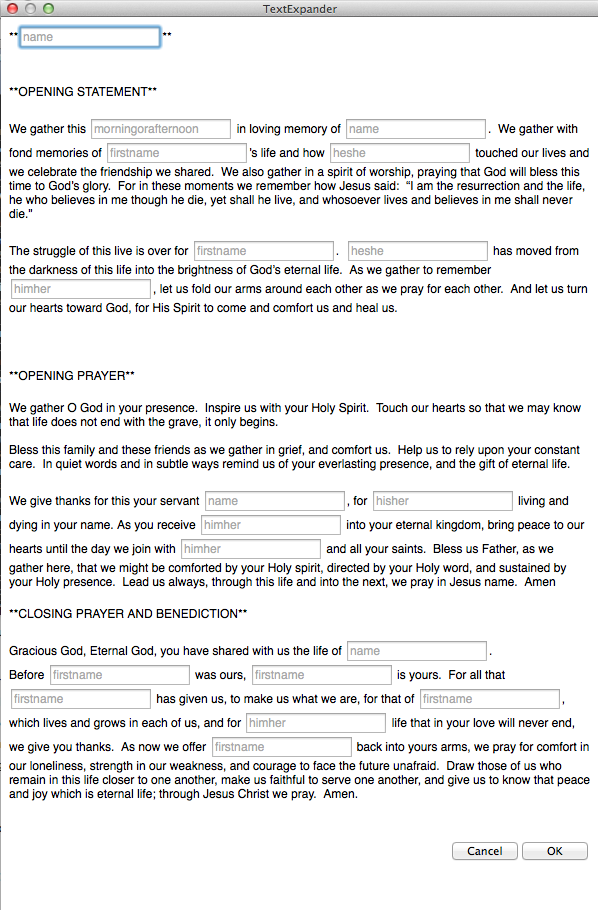
The great thing about this is, when there are two or more %fill:% items that are exactly alike, it fills the others as you type (I typed my first name and part of my last name for %fill:name% to show you).
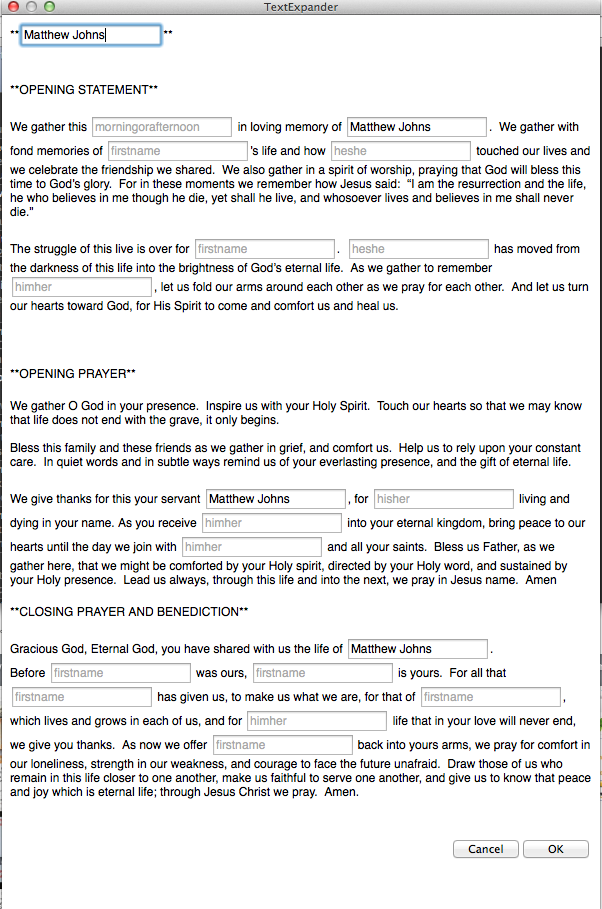

I can't recommend templates or TextExpander highly enough.
Prepositions
I never liked reading an essay or hearing a speaker begin with, "The dictionary defines..." What a rotten way to begin a thought, right? Maybe it is rotten, but I actually had to look up something tonight in order to write down what was on my mind. The title of this blog comes from the Francis Asbury quotation over there on the left. You can take a second to read it if you'd like. I'll wait.
I've been using a pencil and a piece of paper during the last couple of weeks to map out what I want this blog to exist for. I don't really want to write about the random things I think about. I want it to have focus so that I can discipline myself and get down to writing. One thought that keeps recurring is, "Why not the holiness Francis was talking about in that quotation?" It's a decent question. My dissertation is going to be about sanctification in the Wesleyan tradition. Why not blog about it, too? Or is that too narrow a focus?
Being the slightly distracted person I am, I left the holy part of the quotation and started fixating on the "live more to God" part. That's an odd choice of prepositions, isn't it? I tell people all the time when I'm teaching the Bible that the prepositions are the most important words in any passage. I get strange looks from time to time, but if you were nursed by the inductive method like I was in seminary, you'd probably agree. Why, "to"? Why not "live more for God" or "live more in God"? Those make a little more sense, especially if you take our religious jargon into account.
I did what I despise. I looked up "to" in the dictionary. The funny thing is, "to" is a pretty versatile preposition. Most of the definitions made sense.
- "Identifying the recipient of something." God receives my life.
- "Identifying a particular relationship between one person and another." Living to God identifies the relationship involved in living.
- "Indicating that two things are attached." There's a candidate for a discussion on holiness.
The one I liked the best was "expressing motion in the direction of". Brian Russell, Asbury Seminary professor and friend, once talked about repentance in terms of "realignment". The Hebrew word for "repent" basically means "to turn" (that's a bit simplistic but it'll work). Turn toward what? Turn from what? Answer: turn from sin and turn toward God. It's a simple (at least in theory) realignment of our hearts with God's heart. When you're off course in a boat, you've got to turn the wheel until you've realigned yourself with the course that's been set. Is this not what it means to express motion in the direction of God?
I think, despite the slight embarrassment for having to look up a word I've been using since I started talking, that I'm finding the focus for writing I've been looking for. What does life look like when it's sailing in a Godward direction? How do we realign when we get off course? Those are questions I want to dig into for life and if they spill into a blog, great. I'll see what happens.
Joy and suffering
There's a lot in this post by Jared Wilson that resonates with me because of what we're going through at our church. Let's pray, friends, for one another and for healing.
A new beginning
I'm doing a little spitballing here.

I do not like the practice of Christians telling people to begin a relationship with Jesus by "asking Jesus into your heart." Maybe I haven't read the Bible through enough times but I think it's a terrible practice. Nowhere does Jesus say, "Ask me into your heart and that's that." Jesus tells people to follow him. Asking Jesus into one's heart is passive: it's a one time event that, given the state of American Christianity, doesn't require much of the inviter. On the other hand, following Jesus is a daily practice of discipleship (Luke 9:23) that demands much of the believer and is consistent with the witness of the New Testament.
This is on my mind at the moment because several of the men on our church are about to help on a weekend event designed to help men encounter Jesus. One guy asked me this recently: "What do we do if someone decides to become a Christian? How can I help them do that?" It's a great question. I've discouraged people in the past from merely thinking about conversion as "asking Jesus into your heart" and I often explain what it means to follow Jesus. In doing so, I remind them that if you get up out of your chair to follow someone, there is a first step and I think a prayer acknowledging that is helpful. But what to pray? I've been scratching out some ideas, and here's the rough draft:
Jesus Christ, the Son of God and Lord of all:
Through your love and grace, this is the moment I choose to follow you. I believe that you are Lord and that God raised you from the dead and now I want to follow you by denying myself and taking up my cross. Hear my confession of my sin. You are faithful and just. Thank you for forgiving me and cleansing me from all my sin. With the gift of your Holy Spirit, I pray that your work in me will bear fruit as I am now a new creation; the old is gone and the new has come. Thank you, Jesus. AMEN.